
1JZ-GTE: the twin turbo of the JZA70 Supra
The 1JZ-GTE is Toyota's 2.5-liter twin-turbo inline-six. In the Supra it was fitted only to the Japanese-market JZA70 from August 1990, rated at 280 PS like the later 2JZ-GTE. Outside Japan it is best known as the engine MKIII owners swap in for the 7M.
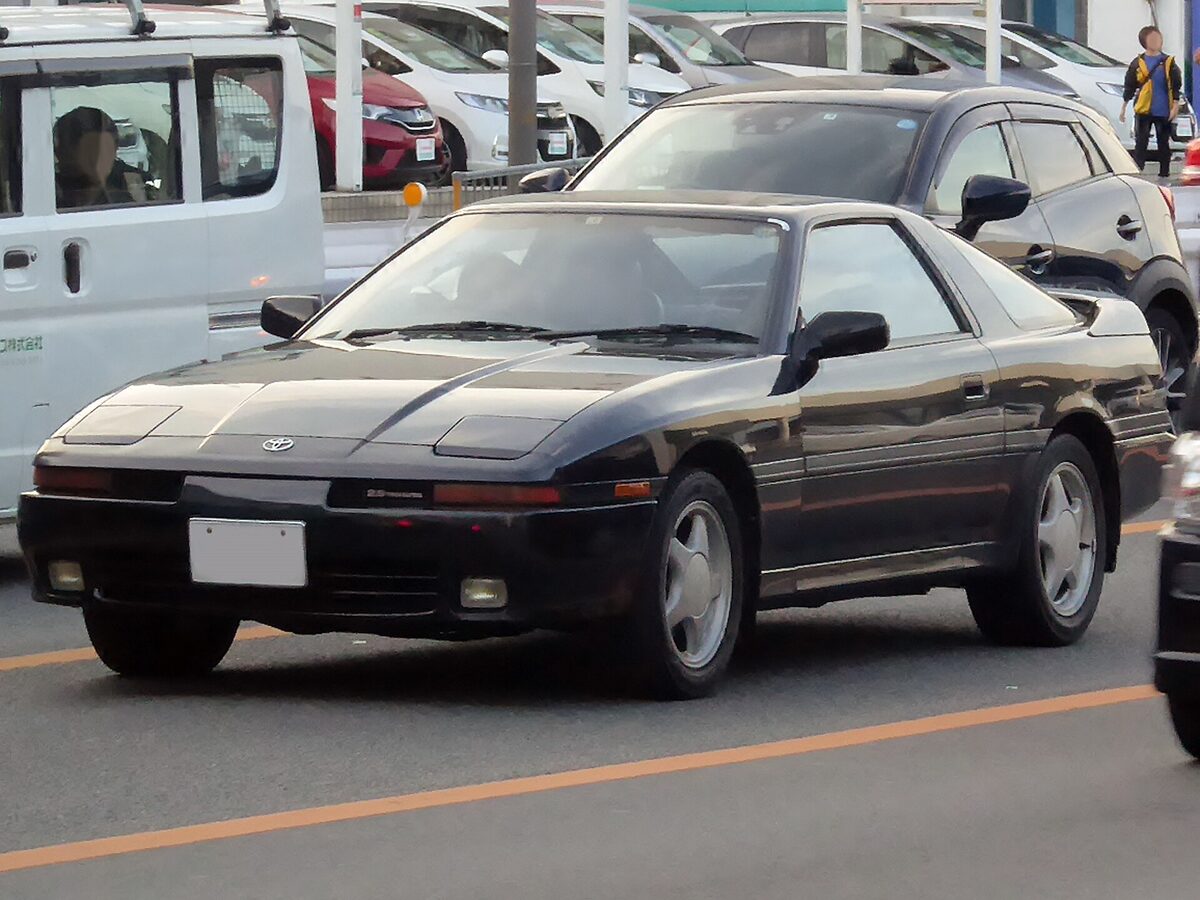

- Displacement
- 2,491cc
- 2.5 L inline-six
- Power
- 280PS
- at 6,200 rpm
- Torque
- 363Nm
- 37.0 kgf·m at 4,800 rpm
- Turbos
- 2 × CT12A
- in parallel, intercooled
1JZ-GTE specifications#
| Type | Inline-six, DOHC, 24 valves, belt-driven camshafts, fuel injection, twin turbochargers with intercooler |
|---|---|
| Displacement | 2,491 cc (2.5 L, 152 cu in) |
| Bore × stroke | 86 mm × 71.5 mm (3.39 in × 2.81 in) |
| Compression ratio | 8.5:1 |
| Turbochargers | Two Toyota CT12A in parallel, ceramic turbine wheels |
| Power | 280 PS (206 kW, 276 hp) at 6,200 rpm |
| Torque | 363 Nm (37.0 kgf·m, 268 lb-ft) at 4,800 rpm |
| Fuel | Unleaded premium |
| In the Supra | 1990-1993, JZA70, Japanese market only |
At the time, 280 PS was the most a Japanese road car was allowed to claim. So the 1JZ-GTE Supra and the 3.0-liter 2JZ-GTE Supra that followed it carry the same official figure.
The 1JZ-GTE Supra: JZA70#
Toyota put the 1JZ-GTE into the Supra with the August 1990 update of the Japanese-market MKIII, where it replaced the 3.0-liter 7M-GTE. From then on, the Japanese MKIII came only with 2.0-liter engines or this 2.5 twin turbo.
The car is the JZA70, sold as the 2.5GT Twin Turbo in five versions, each with a five-speed manual or a four-speed automatic. Besides the base car there were the aero top with a removable roof panel, the sportier Twin Turbo R, the better-equipped Limited and the Limited aero top. The R added a larger intercooler, a Torsen differential, firmer suspension and Recaro seats.
| Version | Transmission | Price | Frame |
|---|---|---|---|
| 2.5GT Twin Turbo | Manual | 3,070 | E-JZA70-BLMVZ |
| 2.5GT Twin Turbo | Automatic | 3,163 | E-JZA70-BLPVZ |
| 2.5GT Twin Turbo aero top | Manual | 3,224 | E-JZA70-BJMVZ |
| 2.5GT Twin Turbo aero top | Automatic | 3,317 | E-JZA70-BJPVZ |
| 2.5GT Twin Turbo R | Manual | 3,289 | E-JZA70-BLMQZ |
| 2.5GT Twin Turbo R | Automatic | 3,382 | E-JZA70-BLPQZ |
| 2.5GT Twin Turbo Limited | Manual | 3,549 | E-JZA70-BLMZZ |
| 2.5GT Twin Turbo Limited | Automatic | 3,642 | E-JZA70-BLPZZ |
| 2.5GT Twin Turbo Limited aero top | Manual | 3,703 | E-JZA70-BJMZZ |
| 2.5GT Twin Turbo Limited aero top | Automatic | 3,796 | E-JZA70-BJPZZ |
The catalog lists the Twin Turbo R with the manual transmission at 1,520 kg and the base car with the automatic at 1,550 kg. For the full list of 1991 versions, including the 2.0-liter GA70 cars, see 1991 Toyota Supra JZA70 specs and modifications.
1JZ-GTE vs 7M-GTE vs 2JZ-GTE#
Three turbocharged sixes powered Supras from 1986 to 2002. The 1JZ-GTE sits between the other two: it is smaller than both, with the twin-turbo layout of the 2JZ and the age of the 7M.
| Spec | 7M-GTE | 1JZ-GTE | 2JZ-GTE |
|---|---|---|---|
| Supra | MA70, 1986-1992 | JZA70, 1990-1993 (Japan) | JZA80, 1993-2002 |
| Displacement | 2,954 cc | 2,491 cc | 2,997 cc |
| Turbos | One | Two, in parallel | Two, sequential |
| Compression | 8.4:1 | 8.5:1 | 8.5:1 |
| Power | 232 hp at 5,600 rpm (US) | 280 PS at 6,200 rpm | 280 PS at 5,600 rpm (Japan) |
| Torque | 344 Nm | 363 Nm at 4,800 rpm | 431 Nm at 3,600 rpm (Japan) |
The 1JZ makes its torque high in the rev range, with the peak at 4,800 rpm. The bigger 2JZ makes much more of it, and lower down, at 3,600 rpm. For head-to-head comparisons, see the forum threads 7MGTE vs 1JZ TT vs 2JZ TT and the difference between a 1JZ and a 2JZ. More on the other two engines: 7M-GE and 7M-GTE specs and 2JZ engine specs.
Half trueThe 1JZ-GTE and the 2JZ-GTE make the same power.
On paper, yes: both are rated at 280 PS, the most a Japanese road car was allowed to claim at the time. The 2JZ-GTE makes much more torque, 431 Nm at 3,600 rpm against 363 Nm at 4,800 rpm.
Source: Japanese catalog data on this site
Known weak points and later versions#
Weak point
Ceramic turbine wheels
The CT12A turbos on the first engines have ceramic turbine wheels, which can break up at high shaft speeds and temperatures. That makes turning up the boost on the original turbos risky.
Weak point
One-way valve on the cam cover
A faulty one-way valve on the intake cam cover lets crankcase gases into the intake, so oil vapor reaches the turbos and wears out their seals. Toyota recalled the early engines in Japan and changed the part on later ones.
In 1996, after the Supra had moved on to the JZA80, Toyota reworked the engine. It got VVT-i variable valve timing, a single CT15B turbo instead of the twins and a 9.0:1 compression ratio. Torque rose to 379 Nm at only 2,400 rpm, while the official rating stayed at 280 PS.
The "VVT-i 1JZ" from the Chaser, Mark II and Cresta Tourer V, the Soarer and the Crown Athlete is the version most often found for swaps today. Owners compare the two in the forum thread 1JZ non-VVT-i vs VVT-i.
How to tell the first 1JZ-GTE from the VVT-i engine
- TurbosTwo CT12A turbos in parallel on the first engines, a single CT15B on the 1996 VVT-i engine.
- Valve timingOnly the 1996 engine has VVT-i variable valve timing.
- Compression8.5:1 on the first engines, 9.0:1 on the VVT-i engine.
- Torque363 Nm at 4,800 rpm on the first engines, 379 Nm at only 2,400 rpm on the VVT-i engine.
- Donor carAn engine from a JZA70 Supra is always a first-series twin turbo, because the Supra had moved on to the JZA80 by 1996. VVT-i swap engines come from the Chaser, Mark II and Cresta Tourer V, the Soarer and the Crown Athlete.
The 1JZ swap into a MKIII#
Because the 1JZ-GTE and the 7M both came from the factory in the MKIII engine bay, the 1JZ swap is the most discussed engine change on our MKIII board. One of the most-read threads on the forum is the MKIII 1JZGTE swap how-to, written by a member who did the swap in an '89 Targa Turbo. His main advice:
- Buy a whole front clip rather than a bare engine. You see the real mileage and the condition of the oil and coolant, and you also get the intercooler, its piping and the hydraulic fan.
- Plan for the wiring harness. The 1JZ-GTE came only in right-hand-drive cars. In a left-hand-drive car its harness is about 18 inches too short to reach the ECU, so it has to be extended.
- Replace the clutch, the valve stem seals and the timing belt before the engine goes in. Engines that have sat for years often start smoking because of hardened valve seals.
- Keep a fan. Without the hydraulic fan, you need a water pump without the fan drive (owners use a 2JZ pump) and an electric fan.
Before you decide, read why owners chose it in the threads Why 1JZ-GTE? and 7MGTE swap vs 1JZ swap.
Popular 1JZ questions from our forum#
- Swapping a 7MGE for a 1JZ-GTE
- 7MGTE to a 1JZ or a 2JZ?
- 1JZGTE horsepower potential
- The 1JZ/7M front-facing intake manifold
- 1JZ swap: right-hand drive conversion?
- MKIII 1JZ-GTE VVT-i swap
- Turbo upgrade on a 1JZ-GTE
- 1JZ over fueling
- Is the 1JZGTE a good engine?
- An owner's 92 Supra 2.5 1JZ, with photos
Ask anything not covered here in the MKIII Supra forum.
Questions and answers#
What is the difference between the 1JZ and the 2JZ?
Displacement and turbos. The 1JZ-GTE has 2,491 cc and, in its first version, two turbos in parallel; the 2JZ-GTE has 2,997 cc and two turbos in sequence. Both were rated at 280 PS, but the 2JZ-GTE makes more torque, and lower down.
How much horsepower does a 1JZ-GTE have?
Rated at 280 PS (206 kW, 276 hp) at 6,200 rpm, the first 1JZ-GTE makes 363 Nm (268 lb-ft) at 4,800 rpm. The 1996 VVT-i version kept 280 PS and made 379 Nm at only 2,400 rpm.
Will a 1JZ fit in a MKIII Supra?
Yes. The 1JZ-GTE came from the factory in the Japanese MKIII, and the swap is the most discussed engine change on our MKIII board. In a left-hand-drive car the engine harness is about 18 inches too short to reach the ECU, so it has to be extended.
What are the weak points of the 1JZ-GTE?
The ceramic turbine wheels of the original CT12A turbos can break up at high shaft speeds and temperatures, so more boost on them is risky. A faulty one-way valve on the intake cam cover can let oil vapor reach the turbos and wear their seals.
Article history
- The old list of 1990 catalog versions became a full 1JZ-GTE article: specs, the JZA70 versions, the 7M-GTE and 2JZ-GTE comparison, weak points and the MKIII swap. Also added a quick summary, a myth-or-fact card, a guide to telling the first engine from the VVT-i version and answers to common questions.
- First published on toyota-supra.info.
Written and kept up to date by Alex Keller. Found a mistake? Write to info@toyota-supra.info.
Sources
- Japanese catalog data on this site: 1990 and 1991 Toyota Supra versions (power, torque, bore and stroke, weights, prices)
- Toyota JZ engine article on Wikipedia (1JZ-GTE section)
- Discussions of toyota-supra.info forum members, above all the MKIII 1JZGTE swap how-to
Photos are published under Creative Commons licenses; authors are credited under each photo. Copyright questions: info@toyota-supra.info.